.gif)



Most founders treat funding structures as a yes/no decision. Either you get equity or debt. But that's like trying to navigate by asking "North or South?" when you actually need coordinates.
Funding structures are much more complex. That’s why they need precise questions to get them right. In this article, you’ll learn what startups need to pay attention to when structuring their funding. The recommendations are based on 500+ startup funding structures we have worked on to date.
TL;DR
- Stop thinking "debt vs. equity." The right funding structure matches capital behavior to purpose and avoids using whatever money happens to be available.
- Design for the downside, not the deck. Strong structures preserve optionality when reality diverges: model best/base/downside cases, pick terms that don’t turn “60% growth” into a technical failure, and avoid valuations or covenants that require perfect execution.
- Boring wins. The best setups raise less than they could, stay disciplined, and choose terms and partners that behave reasonably under stress, because every euro comes with second- and third-order constraints that shape your future.
How we learned to see startup funding structures differently
We provided more than €100M in debt funding to startups and growth companies. We’ve seen a lot of funding structures and capital stacks. Based on these experiences, a pattern emerged:
The startups that used their funds well had robust funding structures – deliberate combinations of capital types, terms, and timing. Such structures matched their operational reality. The ones that got into funding problems weren't struggling because debt or equity is risky. It was because they were using the wrong tool for the wrong job.
What we see: most funding structures aren't designed at all. They're improvised and too late taken care of, optimized for closing the current round rather than planning the next 24 months.
The delusion of the perfect plan
Building a funding structure starts with a business plan. The business plan reveals what a startup needs money for. But business plans are a hypothesis about the future. Some hypotheses prove accurate. Most encounter friction when they meet reality: markets shift in ways you can't predict, or that anchor customer you were counting on might churn.
How this looks in practice
A startup raised €10M at a €40M company valuation based on projections of €20M ARR in four years. Eighteen months later, they had €2M ARR. It’s solid progress, but slower than projected and certainly not made for a VC case. That €40M valuation had created expectations of 3-digit annual growth rates, so their growth looked like failure rather than what it actually was: a company building solid fundamentals.
The question is whether your funding structure is prepared for this.
This is where most founders get it backwards. They treat fundraising like a transaction to be optimized: maximize valuation, minimize dilution, close the round. But funding structures are architectural, and architecture is about how a system behaves under stress.
You wouldn't design a building to withstand only perfect weather conditions. You design it to handle wind and temperature swings. The same logic applies to funding. A strong structure isn't one that looks impressive on the term sheet. It's one that gives you options when the plan inevitably changes.
Are you looking for an addition to your funding structure?
re:cap offers a non-dilutive credit line at flexible terms to support startups with both long-term and short-term needs.
Explore our termsThe six dimensions of building a funding structure
What we've learned is that capital isn't just money or a one-time decision: It's behavior, constraints, and relationships that shape how your company operates for years.
Here are six dimensions that help establish a funding structure and a better understanding of the consequences of each decision.
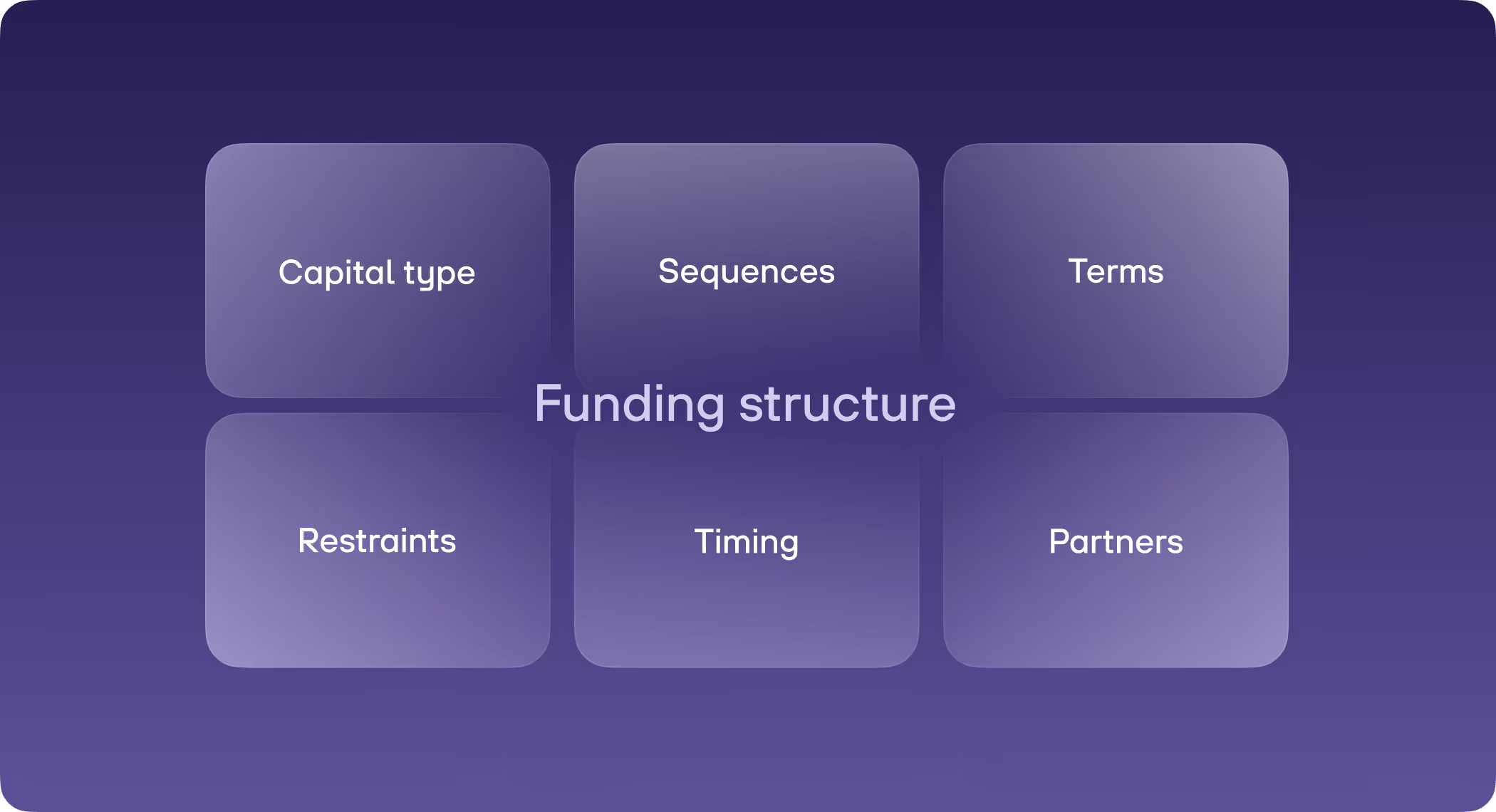
Dimension 1: Capital type
Different capital types serve different purposes. The most resilient funding structures we've seen combine them strategically.
Equity is patient
Equity doesn't demand repayment and monthly obligations. For uncertain investments (new markets, unproven products, R&D), this patience is essential.
However, equity isn't neutral. It comes with growth expectations that compound faster than most businesses actually grow. Venture capital can produce spectacular successes. We've also seen it suffocate companies under their own growth expectations, forcing them to scale before they were ready because the funding structure demanded it.
Debt is simple and numbers-driven
You borrow, you repay: this simplicity makes debt excellent for predictable, proven use cases with measurable ROI. But it creates time-bound pressure. Debt doesn't care if your anchor customer churned or if the market softened. Repayments don't adjust to your operational reality.
The failure mode we observe is founders choosing capital based on what's available or what their peers are doing – not what fits them. A company with unpredictable cash flows takes on debt because it is faster than raising equity. A company with proven, scalable revenue raises equity because that's what "startups are supposed to do."
Both are structural errors that compound over time. So the capital type should fit its purpose.
How this looks in practice
A B2B SaaS company had interest from VC for an €8M Series A at a €35M valuation. They also qualified for a €2M credit line and a €1M R&D grant. Instead of taking the full €8M in equity, they took €4M at a €25M valuation, plus the credit line and grant.
This gave them 18 months to reach €3M ARR while preserving €4M in equity capacity and lowering growth expectations from 100% to 60% YoY – room to make strategic decisions without investor pressure. Twelve months later, they hit €3.2M ARR with 75% retention and raised a €12M Series B at €60M valuation. The structure worked because the company included different funding instruments, not focussing on one. Depending on the performance, this builds options for later funding rounds.
This is a rational construction of funding structures that match capital to operational reality.
Dimension 2: Terms
This is where some founders become careless. They focus on headline numbers and skim the fine print. But terms determine how capital behaves in practice.
For equity
- What board seats are you granting?
- What approval rights?
- What happens if you miss growth targets?
For debt
- Is it a revolving facility that scales with revenue, or a term loan with fixed repayments regardless of performance?
- What's the interest-only period?
- What covenants are you agreeing to?
- What happens if you breach a covenant or miss a payment?
We've seen founders accept harsh liquidation preferences because their runway and performance left them no choice. When you're three months from zero and your metrics are off-target, you take the deal on the table. Years later, those preferences meant that even a €50M exit left them with almost nothing, because all proceeds went to preferred shareholders.
The mistake wasn't accepting bad terms in a corner. The mistake was ending up in that corner in the first place, missing the moment to build leverage when they still had runway and options.
Companies agree to aggressive growth covenants that seemed reasonable in a bull market, then find themselves in technical default when conditions shifted, not because they were failing but because they were growing at 60% instead of 100%.
Every term creates constraints. Some constraints are productive, and they align incentives and force discipline. Others are time bombs. The problem is you often can't tell the difference until it's too late.
The strongest funding structures were negotiated by founders who understood that terms aren't legal formalities. They're the operating system of your business for the next 2-3 years.
Dimension 3: Partners
Capital doesn't just come with behavior. The people behind it do too.
For equity, this is critical. You're entering a relationship that will last years. And like any relationship, the problems don't emerge during the honeymoon phase. They emerge when things go sideways.
Your lead investor can be supportive – until growth slows. Then they begin pushing for aggressive cost-cutting. When you resist, the investor could threaten to block your next round unless you comply. Things and relationships can get ugly very fast. Your considerations on the funding structure should take this into account.
But not all investors act this way. The best ones support you through uncertainty. They have tough conversations but trust founders to navigate complexity. They understand that companies rarely follow straight lines.
For debt, the dynamics are simpler but equally important. If you get debt from a lender who is familiar with startups and growth companies, covenants should trigger conversations, not automatic defaults. If a company misses a target because it deliberately chose to invest in long-term product improvements instead of short-term revenue, that's different from missing targets because fundamentals are broken.
The difference between rigid enforcement and flexible partnership matters immensely when you're nine months into a 24-month plan and realize you need to adjust course.
Dimension 4: Restraints
A €20M VC round feels like a victory. The bank account is full. More time to figure things out. We've seen this pattern repeatedly because what happens too often: discipline dissolves, and operating costs skyrocket.
Well-structured companies raise less than they could. This sounds counterintuitive. More money means more runway, right? In theory, yes. In practice, more money creates more pressure.
How this looks in practice
One company burned through €6M in twelve months, and their burn rate went up from €150K to €400K in monthly revenue. When they approached investors for their Series A, the response was: "What did you spend the money on?" They had no good answer. They'd scaled the team from 12 to 45 people. The implied customer acquisition cost was bad. No rational investor continues funding this.
The real world catches up fast. It starts with flat valuations. It ends with continuous equity injections from existing investors just to keep the lights on, each one at worse terms than the last. By the time you approach new investors, you're staring at years of burned capital with no corresponding value creation.
Large funding rounds sound like optionality. However, they often function as constraints, pushing you to scale before you're ready and distorting decision-making due to investor expectations rather than customer needs.
Dimension 5: Sequences
Bad funding decisions optimize for the current transaction. Good ones map second and third-round effects they have on the funding structure. Every funding decision constrains the next one. The terms you accept today determine your options tomorrow. The valuation you optimize for today creates the growth expectations you'll need to meet tomorrow.
Accept aggressive growth covenants? You've limited your flexibility to pivot if market conditions change. Grant board seats? You've created voting dynamics that will persist for years, potentially blocking strategic decisions you'll want to make later.
Model three scenarios before signing anything:
- Best case (100% YoY growth): What does the next round look like? Can we raise at a higher valuation?
- Base case (40% YoY growth): Can we still raise at a reasonable valuation? Or are we trapped?
- Downside case (10% YoY growth): Can we reach profitability without raising again?
If the answer to the downside case is "no, we're completely dependent on the next round working out perfectly," you don't have a funding structure.
The strongest funding structures we've seen come from founders who understand that every euro raised creates second and third-order effects that either expand or collapse strategic options.
Dimension 6: Timing
This is the conversation we dread most. A founder reaches out with two or three months of runway left. They're burning €80K monthly. They need €500K in debt to "bridge the gap" until they can raise equity.
The timing pattern that separates strategic funding from desperate funding is consistent:
Companies that use capital effectively and build resilient funding structures start their financial planning months before they need it. They identify when they'll run out of cash and begin conversations early. They build relationships with lenders and investors continuously, not frantically. They understand current terms, market conditions, and the funding landscape before they're under pressure.
This creates two critical advantages:
- They achieve better terms because they're negotiating from a position of strength, not desperation. Lenders offer lower rates and more flexible covenants when you don't urgently need the money. Investors value companies more highly when they're not forced sellers.
- They can choose optimal market windows. They raise equity when valuations are favorable and market sentiment is strong, not when the bank account hits zero.
Good funding structures are boringly correct
The most successful funding structures are often those that are unremarkable. They could look like this:
A logistics software company needed €1.5M to scale their sales team and fund CAC. They had €4M ARR with strong retention and clear unit economics. They could have raised €5M in equity. Multiple VCs were interested. Instead, they took €1M in a revolving credit line, plus €300K from an angel investor who wanted to support the founding team.
Why? Because they did the math. The credit line covered the sales hires and the CAC until customers turned profitable. They could draw money as needed and only repaid what they were using. No fixed repayment obligations that would strain cash flows.
The €300K in equity added an additional buffer and brought on an experienced operator who could help with hiring. Total raise: €1.3M. That’s less than they could have raised. However, the structure gave them maximum flexibility.
Eighteen months later, they hit €4M ARR. They never used more than €800K of the credit line because their cash flows were strong. They raised a €3M Series A at a €25M valuation with minimal dilution because they'd preserved equity capacity and could present strong metrics.
Nothing about this structure was creative.
Such examples are boringly correct. They matched capital to purpose, built in optionality, and focused on fundamentals rather than optimizing for vanity metrics. That's what good funding structures look like. Not aiming for the largest possible (equity) round or creative financial engineering. Just clear thinking about what you're trying to accomplish and what kind of capital fits that purpose.
Summary: The lesson from building funding structures for startups
The core insight is simple: get the capital that fits your purpose, and build structures that create optionality. Everything else follows from these two principles.
Find: Fit for purpose
Fit for purpose means matching capital behavior to operational reality. Equity is for uncertainty. Debt is for predictable returns. Don’t raise equity to cover working capital. Don’t take debt to fund a moonshot. And don’t raise just because someone’s willing to write a check.
Create: Optionality
Optionality means building structures that survive when reality diverges from your plan. Raise less than you could. Model downside scenarios. Choose terms that preserve flexibility. Partner with people who behave reasonably under stress.
The funding structures that fail are the ones built for a single scenario with no room for mistakes or developments that you can’t foresee. Those structures are fragile. They assume perfect execution in an imperfect world.
The funding structures that succeed are built for resilience. They assume reality will be messier than the plan. They create room for adaptation. They preserve options when the plan changes.
The best structures are boringly correct. And that’s not because they lack ambition, but because they recognize that sound architecture matters more than clever engineering.
Every euro you raise comes with second and third-order effects that either expand or collapse your strategic options. The best founders understand this before they sign anything.
Q&A: Startup funding structures
How do I know if I'm raising too much?
Ask yourself: Can I articulate exactly what we'll spend this on and why each initiative is essential? If the answer includes phrases like "gives us room to experiment" or "lets us hire ahead of need," you're probably raising too much. Optionality comes from structural flexibility, not from a large bank account. We've seen companies destroy themselves with too much capital just as often as with too little.
When does debt make sense for early-stage companies?
When you have predictable cash flows that can service repayment. This usually means: proven customer acquisition channels with measurable ROI, recurring revenue with strong net retention, or working capital needs with predictable conversion cycles. If your revenue is lumpy, unpredictable, or you're pre-product-market fit, debt does not fit. Don't use it to fix unpredictable fundamentals.
How do I evaluate if terms are reasonable?
Model what happens in downside scenarios. If you grow at 40% instead of 80%, do the terms become a burden? If you need to pivot, do they give you flexibility or lock you in? If investors have anti-dilution protection, what does your cap table look like after a flat or down round? Terms are reasonable if they align incentives without creating structural fragility. The real test: Can you live with these terms if things go sideways?
What's the biggest red flag in a funding conversation?
Any investor or lender who dismisses your questions about downside scenarios or suggests "don't worry about that, just focus on growth." Partners who won't discuss what happens when things go wrong are partners who won't support you when things actually do go wrong. And they will. Second red flag: Optimizing purely for valuation without considering the growth expectations and structural constraints that come with it.
What should I think about venture capital?
VC is a specific tool for specific outcomes: genuinely uncertain, genuinely ambitious ventures that require patient capital willing to absorb binary risk. It's not a default setting. Ask yourself: Are we pursuing venture-scale outcomes (100x potential)? Do we need capital that doesn't demand repayment during high-uncertainty phases? Are we willing to optimize around future fundraising events? If yes, VC might be right. If not, consider whether venture capital alternatives (debt, grants, bootstrapping, or smaller equity raises) preserve more optionality.
Are you looking for an addition to your funding structure?
re:cap offers a non-dilutive credit line at flexible terms to support startups with both long-term and short-term needs.
Explore our terms